5.Ed Lover weighing in on rap beef (method man,jeezy,gucci,buddens etc..)
4.Dwight Howard's intense workout and training
3.Movie trailor of 'The Blind Side'
2.Eminem - Insane (live)
1.Royce da 5'9 holdin it down for slaughterhouse (hes got joeys back)
Thursday, August 13, 2009

Saturday, August 8, 2009
Friday, August 7, 2009
Thursday, August 6, 2009
Wednesday, August 5, 2009
Weekly top five WHOA Videos
5. Officer Ricky (Rick Ross) Starring in Mento's Commercial!
4.lil Wayne Gay??
3.Amber Rose is a freaky ass bitch (grow the hair tho)
2.Drake practically breaks leg on stage!
1.Lebron james gets shitted on!(whoa)
4.lil Wayne Gay??
3.Amber Rose is a freaky ass bitch (grow the hair tho)
2.Drake practically breaks leg on stage!
1.Lebron james gets shitted on!(whoa)
Tuesday, August 4, 2009
Minor league baseball pitcher convicted of injuring a fan
DAYTON, Ohio -- An Ohio judge has convicted a minor league pitcher of injuring a fan when he threw a baseball that went into the stands during an on-field melee in Dayton last year.
Montgomery County Common Pleas Judge Connie Price on Tuesday found Julio Castillo guilty of felonious assault causing serious physical injury. The judge acquitted the 22-year-old of a second charge of felonious assault with a deadly weapon.
Price announced her decision without comment.
Castillo, of the Dominican Republic, was pitching for the Peoria Chiefs -- a Class A affiliate of the Chicago Cubs -- against the Dayton Dragons when the bench-clearing brawl broke out. Castillo threw a ball that gave a fan a concussion.
He faces a possible 2 to 8 years in prison when he is sentenced Thursday, but the judge could alternatively sentence him to probation.
"We are pleased that this paves the way for some sense of accountability for what happened, and for the victim to be recognized that what happened to him could happen to anyone," said assistant county prosecutor Tracey Tangeman.
Defense attorney Dennis Lieberman said the verdict contained both "good news and bad news" but declined further comment.
During last month's trial, fan Chris McCarthy testified that Castillo appeared angry when he hurled the ball toward the Dragons' dugout. He said the ball came into the stands, striking him in the temple area.
McCarthy, 45, of Middletown, said the seams of the baseball left a mark on his scalp, and he suffered a throbbing headache for days. He said the swelling in his head became so severe that he couldn't wear a hard hat required for part of his job.
McCarthy did not attend the verdict hearing on Tuesday. A message left at a number listed for a Chris McCarthy in Middletown was not immediately returned.
At trial, Montgomery County prosecutor Jon Marshall had accused Castillo of throwing the ball at Dragons' players. He argued that courts have found that such objects as rocks, bricks, pool cues and baseball bats constitute deadly weapons, and Castillo is capable of throwing a baseball over 90 miles an hour.
Castillo said he had been having pitching control problems earlier in the game, became frightened as the brawl began, and threw the ball downward toward the Dragons' dugout to try to keep players from rushing the field. He said he did not throw at any opposing player, nor did he intend to hit anyone.
Video from the game shows Castillo throwing a ball, but doesn't show where the ball lands.
Officials in the Midwest League suspended and fined 15 players and both teams' managers for the fight.
Castillo currently is on the roster of the Boise Hawks, also a Cubs affiliate. He has been benched as the Cubs awaited the outcome of the trial.
Michael Lufrano, general counsel for the Cubs, declined to comment Tuesday.
Copyright 2009 by The Associated Press
WELCOME TO TNGE!!Help this site out!
In the efforts to open a special website developed with the intent to inform the New Generation of world news that they can relate to!This site will include News as well as videos,pictures,sports,musix,games everything you can think of to keep your mind at ease in this recession!Join the staff today and help make this site the social gathering i one day hope it will become! - escalado
30 ALTERNATIVE WONDERS OF THE WORLD!
| taken straight from ATS! | |
| Topic started on 1-8-2009 @ 07:54 AM by Scope and a Beam | |
 +104 more +104 more Thirty Alternative Wonders of The WorldYarlung Tsangpo Canyon, Tibet and Fish River Canyon, Namibia  Many people think the Colorado Grand Canyon is the largest in the world. However, the American Geography Committee announced in 1994 that it was in fact the Great Canyon of Yarlung Tsangpo (Brahmaputra) River in the Himalayas (Tibet) that claimed this title. The giant fissure descends to an astounding 5,382 metres at its deepest point and its length stretches for more than 496km. Another little-known claimant for the world’s biggest gorge is Fish River Canyon, a spectacular site in Namibia. The Slot Canyons of Arizona, US  America’s south-west is scored with numerous sleek slot canyons, narrow fissures in the rock eroded by water and wind over the millennia. The most striking is Lower Antelope Canyon, also known as the Corkscrew, located on Navajo land near Page. Its interior changes constantly with the sun’s rays bouncing down the whirling walls. Andean Penitentes  Fields of ghostly icy figurines dominate certain plains of the high Andes, especially in Chile and Argentina. Known as penitentes (penitents), the eerily humanoid ice sculptures stand still as though in prayer. They are formed at altitudes above 4,000 metres when sunlight is reflected down into the ice blocks, causing variable melting patterns, and can reach heights of more than five metres. Hell’s Gate, Turkmenistan 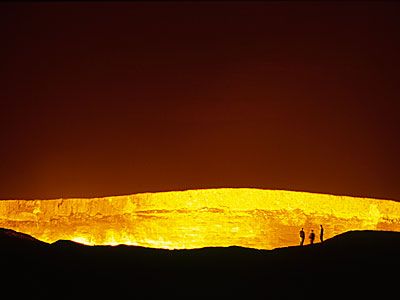 Isolated in the middle of the Kara-Kum Desert of Turkmenistan is a strange blazing crater that has been burning non-stop for 38 years. Nicknamed Hell’s Gate, it is the entrance to an underground cavern filled with natural gas. Geologists discovered the cavern in 1971 when the ground under their drilling rig caved in. They ignited it to prevent the poisonous gas from escaping, and it has been burning uninterrupted ever since. Namib Desert, Namibia  In a list of famous deserts, the Namib falls pretty low. However, this is thought to be the oldest desert in the world and is also home to the planet’s most spectacular sand dunes (Dune Seven reaches as high as 380 metres, making it the world’s highest). The desert is 1,200 miles long but averages a meagre 70 miles wide. Vatnajokull glacier, Iceland  One of the biggest ice caps in the world and the largest in Europe, Vatnajokull smothers south-east Iceland in ice, covering an impressive 8% of the country and measuring around 8,100 sq km. It contains a jaw-dropping 3,300 cu km of ice. In 2008, the glacier and its immediate surroundings were also declared Europe's largest national park. And if those aren't enough records, according to Guinness World Records, Vatnajökull is the subject of the world's longest sightline – visible from an incredible 550km away in the Faroe Islands. Avenue of Baobabs, Madagascar  The so-called Avenue of the Baobabs is a remarkable collection of the huge Malagasy species of baobab, which is endemic to Madagascar. Growing up to 30 metres high, and living for up to 800 years, these trees once stood in dense tropical forest but now tower in lonely isolation. Their immense fire-resistant trunks can reach diameters of 11 metres and can store a mind-boggling 120,000 litres of water to survive through nine months of the dry season. Crystal Cave of the Giants, Mexico  Mexico's Cueva de los Cristales (Cave of Crystals) seems to have jumped straight from the pages of Jules Verne's Journey to the Centre of the Earth. The incredible site is home to a forest of colossal gypsum shafts spanning up to 11 metres in length and more than a metre in diameter. Buried in the mineral-rich lands of the Chihuahua region, the crystals are estimated to be more than half a million years old. The cave in which they are found sits above an intrusion of magma, the heat of which – combined with the cave's mineral-rich groundwater – allowed the crystals to form. Bioluminescent Bay, Vieques, Puerto Rico  This shallow, mangrove-lined cove on the south coast of Vieques is the best example of a bioluminescent bay in the world: a rare natural site in which a type of plankton that uses light as a defence mechanism flourishes. When the waters are disturbed, whether by fish, boats or people swimming, these microscopic dinoflagellates emit a trail of eerie bluish-white light easily visible at night. Belize Barrier Reef  While Australia’s Great Barrier Reef grabs all the headlines, the longest barrier reef in the western hemisphere is a close contender in spectacle and richness of marine life. Running for 250km off the coast of Belize, it’s also home to the astonishing Great Blue Hole – a vast, perfectly round limestone cavity and one of the most spectacular dive sites in the world. The chasm runs 145 metres under the surface and is filled with strange stalactite formations that get more impressive the deeper you dive. Richat Structure, Mauritania  This weird bull’s eye feature spans 50km of desert in the Mauritanian Sahara. The structure has been something of a puzzle for geologists ever since it was first spotted from space, as the surrounding area is largely featureless. It’s now thought it was caused by uplift and erosion rather than a meteorite impact. | |
| copyright & usage | |
| Click here for more Fragile Earth topics Hot Topics | Top Topics | This Week | Subscribe | Home | |
| reply posted on 1-8-2009 @ 07:55 AM by Scope and a Beam | |
| Coyote Buttes, Arizona and Utah  Strange, many-hued rock formations litter the border between south Utah and Arizona. This remote but particularly stunning sandy-red structure was all-but unheard of until the past decade. Coyote Buttes encompasses a series of spectacular wave-like ravines of swirling strata formed from 190-million-year-old sand dunes. You have to hike for three miles to reach its most famous feature, The Wave, and, due to the site’s delicacy, visitor numbers are limited. Catatumbo’s everlasting storm, Venezuela  Remember the saying that lightning never strikes in the same place twice? Forget that. A remarkable site at the mouth of the River Catatumbo, branching off Maracaibo Lake in western Venezuela, is the stage for an amazing lightshow on average 150 nights a year, totalling a million flashes annually. Oddly though, no thunder follows the lightning. The bizarre phenomenon is found nowhere else on Earth, and is thought to be the single biggest generator of ozone on the planet. [size=4]Sudan's Mass Migration[/size]  The Serengeti’s annual wildebeest migration has long been thought the largest migration of mammals on earth. But the first aerial survey of southern Sudan in 25 years (since the outbreak of civil war) recently indicated that its herds of an estimated 1.3 million kob antelope, tiang and gazelle might be even bigger. The gigantic column of animals seen in the survey stretched 30 miles wide by 50 miles long. Socotra Archipelago, Yemen  One of the planet’s most isolated landforms of continental origin, the Socotra Archipelago, in the Indian Ocean off the Horn of Africa, has a unique and spectacular endemic flora that rivals that of the better known Galapagos Islands. However, the archipelago’s remoteness makes it a difficult destination for ecotourism. More than one-third of its plant species are found nowhere else, making it one of the world’s most endangered ecosystems. Socotra's most eye-catching plant is the dragon's blood tree, an umbrella-shaped tree with red sap, once much sought after as a medicine. Grand Prismatic Spring, US  The third-largest hot spring in the world, the Grand Prismatic Spring in Wyoming is about 75 by 91 meters in size and 49 meters deep. Its vivid shades of orange, yellow, green and blue are what make it so memorable. The colours are produced by algae and bacteria, which grow around the water’s edge. Monarch butterflies, Mexico  In one of the most sensational migrations on Earth, around 250 million monarch butterflies travel south from America every November to the Oyamel fir forests of Mexico, where they fill the sky with a storm of orange and black. So dense are their numbers that tree branches sag under their weight. Three main bio-reserves exist to support the butterflies: El Rosario, El Capulin and Piedra Herrada. Wulingyuan National Park, China  China’s Hunan Province is home to an astonishing national park crowded with more than 3,000 towering sandstone columns, hundreds of metres tall. The quartzite sandstone pillars are what remains of an ancient sea floor, and in among them can be found beautiful waterfalls, deep valleys, spectacular limestone caves and lush forest thick with orchids and lotus. Kamchatka Peninsula, Russia  This wild Russian peninsula is the world's most active volcanic region and also contains the planet's second-biggest geyser field, the Valley of Geysers (though it was damaged in a recent mudflow). It’s a landscape of fire and ice, steaming cones and vivid blue crater lakes, where the land is younger than many of its visitors. Isla de Malpelo, Colombia  This 350-hectare slab of sheer basalt thrusting out of the Pacific Ocean is the peak of a hot spot in the oceanic crust, 500km off Colombia’s Pacific coast. Its claim to uniqueness, however, lies in the clear waters below. Malpelo has the largest shark population in the world; there are shoals of more than 500 hammerheads, hundreds of silkies and recently discovered species of sand sharks here. The ‘hells’ of Beppu, Japan  Beppu’s sacred hot springs comprise the largest volume of hot water in the world outside Yellowstone park in the US. The area includes a handful of big hot spots – each very different in character – nicknamed the "nine hells". They range from a steaming pond of electric blue called Sea Hell to boiling mud pools and a milky-coloured white spring to Monster Mountain Hell, where crocodiles are bred. However the most striking by far is Chinoike Jigoku, Blood Pond Hell, a scarlet-bright pond of red, scalding waters. [edit on 1-8-2009 by Scope and a Beam] | |
| copyright & usage | |
 | |
| reply posted on 1-8-2009 @ 07:55 AM by Scope and a Beam | |
| Tsingy of Bemaraha, Madagascar  A magnificent forest of limestone needles in western Madagascar, the Tsingy of Bemaraha is a worthy rival to the more famous hoodoo canyons of the Americas. However, it’s packed so tightly together that it’s all-but impenetrable to humans. Instead its undisturbed forests, lakes and mangrove swamps are inhabited by a singular collection of endangered lemurs and birds. The Lofoten Maelstrom, Norway  This watery abyss inspired both Edgar Allen Poe’s A Descent into the Maelstrom and Jules Verne’s Twenty Thousand Leagues under the Sea. One of the world’s most ferocious eddies, it appears twice a day just off the Lofoten Islands in northern Norway. As the tide runs back into the main stream, it triggers huge whirlpools that spiral down into the depths at high speed. Iguaçu Falls, Brazil-Argentina border  The awe-inspiring Iguaçu Falls may be the best-known natural wonder on our list but in the UK, at least, we’re far more likely to have heard of Niagara and Victoria Falls than we are this whopper of a waterfall. Found on the border between Argentina and Brazil, Iguaçu is actually a collection of almost 300 cascades that together span an incredible 2.7km and fall as far as 70 metres (much taller than Niagara and almost twice its width). Goreme National Park, Turkey  Containing one of the world’s most surreal landscapes, Göreme national park in Turkey is filled with soft tuff pillars, mushrooms, needles and waves. Many of its so-called fairy chimneys have been hollowed into troglodyte dwellings and churches. Blue Grotto, Italy  The Blue Grotto is a spectacular accident of nature. Found on the Italian island of Capri, this soft limestone cave is suffused by an eerie blue light. The light comes from another underwater entrance to the cave and is reflected off the white cave floor. Roman emperors supposedly used the grotto as a private bath. Salar de Uyuni, Bolivia 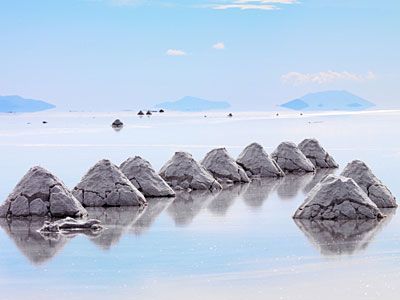 Though well known in South America and in travellers’ circles, the Salar de Uyuni - the world's largest salt flat – and its surrounding landscape still have a low profile internationally thanks to the harsh conditions and difficulty of travel in the region. But this is one of the world’s most dazzling natural wonders: a solid 4,000-square-mile lake of whitest salt, 3,700 metres high in the Andes. The salar, formed by the evaporation of a giant prehistoric lake, is surrounded by mineral-rich land with lakes of electric blue, red, white and green, weird rock formations and hot springs. Shark Bay, Australia  Of all the natural wonders on this list, Shark Bay is perhaps the most significant. Though it’s hardly extraordinary to look at or even particularly well-known outside the country, this bay in north-western Australia contains strange little hillocks formed by some of the earliest life-forms on earth – marine stromatolites. To these 3,500-million-year-old organisms all life as we know it owes its existence, on account of the way they absorb carbon dioxide and emit oxygen. Bracken Cave, Texas  It’s hard to imagine 20 million animals living huddled together in one cave little bigger than a football field. But that is exactly what can be found at Bracken Cave, near San Antonio, which contains the biggest bat colony in the world and the largest known concentration of mammals on the planet. At twilight, an immense river of bats – all 20 million of them – stream out of the cave in a column so thick that it shows up on air traffic control. Parícutin Volcano, Mexico  Parícutin is a remarkable cinder cone volcano in west central Mexico that formed within living memory – in 1943 – making it the youngest volcano in the western hemisphere. Local townsfolk watched on as it grew from nothing to a substantial volcano within hours and then went on to reach 2,807 metres above sea level within a year. A nearby village was buried but, miraculously, few people died from the event. | |
Subscribe to:
Posts (Atom)
